You're staring at a syllabus that includes linear algebra, machine learning, probability, DBMS, and Python — all for a single exam. That's GATE DA, and picking the wrong course to prepare for it wastes months you can't get back. A structured gate da course turns that overwhelming list into a clear, sequenced preparation path. This guide covers what's inside a good course, how much it costs, and what separates effective programs from expensive ones — so you invest your time and money in the right place. According to IIT Roorkee's GATE 2025 official statistics, GATE DA had a qualifying rate of approximately 19% (11,007 qualified out of 57,054 appeared in 2025), meaning over 80% of appearing candidates didn't qualify. Structured preparation directly closes that gap.
GATE DA: Graduate Aptitude Test in Engineering — Data Science and Artificial Intelligence, a national-level exam for IIT/IISc admissions and PSU recruitment.
What Is a GATE DA Course and Who Should Take It?
A gate da course is a structured coaching program covering the full GATE Data Science & AI syllabus — including mathematics, statistics, machine learning, AI, DBMS, and Python/DSA — designed to help candidates score high enough for IIT or IISc admissions.
GATE DA is the newest GATE paper, introduced in 2024 by IISc as the organizing institute. It targets students from computer science, data science, statistics, and mathematics backgrounds who want to pursue M.Tech or M.S. programs at top institutions.
A gate da course is specifically for you if:
- You're targeting IIT/IISc for M.Tech in data science, AI, or related disciplines.
- You want a PSU job where GATE DA scores are accepted in recruitment cycles.
- You're self-studying but need a structured framework to avoid syllabus gaps.
- You scored below your target in a previous GATE attempt and need a reset.
The exam is more competitive than it looks from the outside. The GATE DA qualifying cutoff for General category candidates has been in the range of 26–37 marks (26.4 in 2026, 29 in 2025, 37.1 in 2024) out of 100. IIT admissions, however, require consistently 55+ marks. That gap only closes with disciplined, syllabus-aligned preparation — not YouTube playlists stitched together without structure.
Also Read: GATE DA Complete Guide 2027
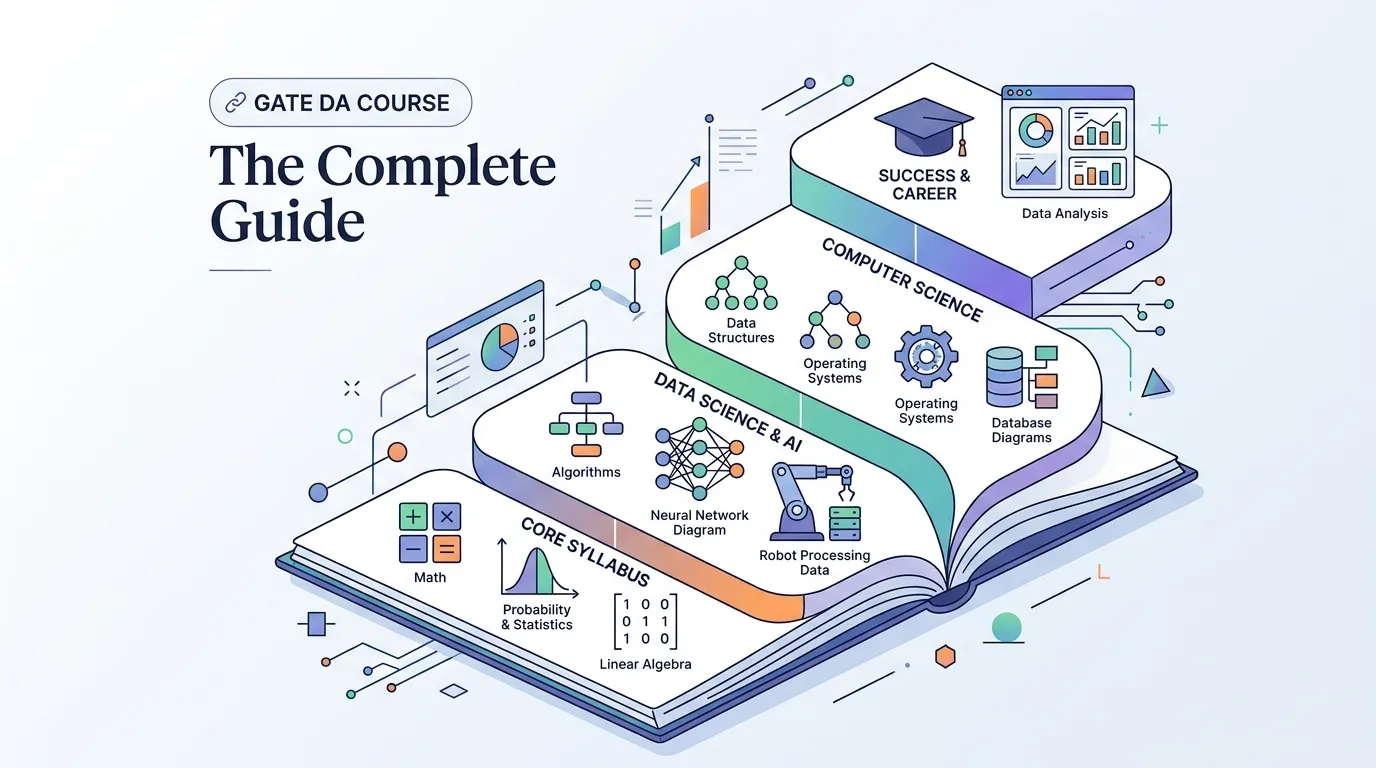
What Does a GATE DA Course Syllabus Cover?
A quality gate da course covers seven core subject areas: Probability & Statistics, Linear Algebra, Calculus, Machine Learning, Artificial Intelligence, Programming & Data Structures, and Database Management Systems. The seven DA subjects together carry 85 marks; General Aptitude carries 15 marks, for 100 marks total. No fixed subject-wise DA marks are published.
Understanding the syllabus distribution helps you evaluate any course quickly — ask if any of these seven are missing or underrepresented.
Mathematics, Statistics, and Probability
These areas provide prerequisites for ML and AI. The official topics include:
- Probability — Counting; axioms, sample space and events; independent and mutually exclusive events; marginal, conditional and joint probability; Bayes' theorem; conditional expectation and variance; random variables; PMFs, PDFs, CDFs and conditional PDFs
- Distributions and statistics — Discrete uniform, Bernoulli, binomial and Poisson; continuous uniform, exponential, normal, standard normal, t and chi-squared; mean, median, mode, standard deviation, correlation, covariance, CLT, confidence intervals, z-test, t-test and chi-squared test
- Linear algebra — Vector spaces and subspaces, linear dependence and independence; projection, orthogonal, idempotent and partition matrices and their properties; quadratic forms; linear systems, Gaussian elimination, eigenvalues, eigenvectors, determinant, rank, nullity, projections, LU and SVD
- Calculus and optimization — Single-variable functions, limits, continuity, differentiability, Taylor series, maxima, minima and single-variable optimization
Partial derivatives, gradients and the chain rule may be taught as supporting mathematics for ML, not as a separate official multivariable-calculus or constrained-optimization unit.
A gate da course that treats these as filler content is one you should walk away from. These mathematics subjects provide the foundation for understanding ML algorithms at a deeper level. If you can't differentiate a loss function, you can't answer GATE ML derivation questions.
Also Read: Machine Learning for GATE DA — Syllabus, Books & PYQs
Machine Learning, AI, DBMS, and Programming
A syllabus-aligned course must also cover these official DA topics without assigning them predicted marks:
- Supervised learning — Regression and classification, simple and multiple linear regression, ridge and logistic regression, KNN, Naive Bayes, linear discriminant analysis, SVM and decision trees; bias-variance tradeoff; leave-one-out and k-fold cross-validation
- Unsupervised learning — K-means and k-medoid, hierarchical clustering (top-down and bottom-up; single and multiple linkage), dimensionality reduction and PCA
- Neural networks — Multi-layer perceptron and feed-forward neural networks
- AI fundamentals — Informed, uninformed and adversarial search; propositional and predicate logic; conditional independence representation, exact inference through variable elimination and approximate inference through sampling
- DBMS & warehousing — ER and relational models, relational algebra, tuple calculus, SQL, integrity constraints, normal forms, file organization, indexing, data types; data transformation (normalization, discretization, sampling, compression); multidimensional warehouse schemas, concept hierarchies, measure categorization and computations
- Python & DSA — Python programming; stacks, queues, linked lists, trees and hash tables; linear/binary search; selection/bubble/insertion sort; divide-and-conquer mergesort/quicksort; introduction to graph theory, traversals and shortest paths
Use the official DA syllabus PDF to check course coverage. Optional projects or supporting ML mathematics should be clearly distinguished from that exam checklist.
The GATE DA ML section specifically tests the math behind algorithms — not Python implementation skills. If a course teaches ML only through code demos and skips the mathematical derivations, you'll lose points on every applied theory question.
Also Read: Best Online Courses for GATE DA
How Do You Choose the Right GATE DA Course?
The right gate da course has four non-negotiable features: complete syllabus coverage with concept-first teaching, regular full-length mock tests with performance analytics, strong DBMS and programming modules, and responsive faculty support. If any of these are missing, your preparation has a structural hole.
Here's a practical evaluation framework you can apply to any course before buying:
| Feature | What to Look For | Red Flag |
|---|---|---|
| Syllabus Coverage | All 7 GATE DA subjects covered | Courses skipping DBMS or AI sections |
| Teaching Style | Concept-first, derivation-backed | Formula dumps without explanation |
| Mock Tests | 10 full-length mocks with analysis, alongside topic, subject, and multi-subject tests | Only topic-wise quizzes available |
| Study Material | Updated for current GATE DA pattern | Material recycled from older GATE CS courses |
| Faculty Credentials | IIT/IISc alumni or verified GATE teachers | No verifiable academic background |
| Price Transparency | Clear pricing with demo access | No free trial before purchase |
The gate da course market in India is crowded. Prices range from ₹3,000 for basic recorded video packages to ₹35,000+ for premium live coaching with mentorship. Don't let price be your primary filter. Watch at least two free demo lectures from any course before committing — pay attention to whether the instructor explains why a formula works, not just what it is.
Also check: does the course include previous-year question (PYQ) analysis? PYQs are your single best signal for what GATE DA actually tests year over year.
GATE DA Course Fees: What to Expect in 2025–2027
Gate DA course fees in India typically range from ₹3,000 for self-paced recorded courses to ₹35,000 for comprehensive live online coaching with mentorship and an integrated test series. Offline classroom programs can go higher.
Here's a breakdown by course format:
| Course Type | Price Range | Best For |
|---|---|---|
| Self-paced recorded | ₹3,000–₹8,000 | Students with strong subject basics |
| Live online coaching | ₹12,000–₹30,000 | Students needing schedule and structure |
| Offline classroom | ₹20,000–₹50,000 | Students who prefer in-person interaction |
| Test series only | ₹1,500–₹5,000 | Students who've completed core subject prep |
| Combo (course + test series) | ₹15,000–₹35,000 | Most aspirants targeting IIT admissions |
One important note: a cheaper gate da course isn't always a worse one. Excellent courses exist in the ₹8,000–₹15,000 range. What matters more than price is whether the course content is updated for the current GATE DA paper pattern and includes realistic full-length mock tests with detailed analytics.
Avoid courses that charge premium prices but deliver only recorded videos from three years ago without updates. The GATE DA paper has evolved since its 2024 introduction — your course material needs to reflect that.
Also Read: GATE DA Course Fees — Full Breakdown and Comparison
How to Prepare for GATE DA: A 6-Month Study Plan
Starting six months before the GATE DA exam gives you enough time to cover all subjects twice — once for concept building and once for problem-solving practice. Use the first four months for subject-wise preparation and the final two for revision and full-length mock testing.
Here's a realistic month-by-month breakdown:
- Month 1 — Linear Algebra & Calculus: Cover matrix operations, eigenvalues, single-variable derivatives, Taylor series, and single-variable optimization. These are the mathematical backbone of ML algorithms you'll study later. Solve 20–30 problems per topic before moving on.
- Month 2 — Probability & Statistics: Work through probability distributions, statistical inference, Bayesian methods, and hypothesis testing. Link each concept to its ML application — for example, how Normal distribution underpins Gaussian Naive Bayes.
- Month 3 — Programming (Python & DSA): Focus on Python for data manipulation, algorithm complexity analysis, and fundamental data structures. Practice GATE-style questions — not competitive programming style, which is a different skill set entirely.
- Month 4 — Machine Learning & Artificial Intelligence: Cover supervised/unsupervised learning, neural networks, and AI search and reasoning. Prioritize the mathematics behind each model — GATE tests derivations, not just conceptual labels.
- Month 5 — DBMS & Data Warehousing: Cover relational algebra, tuple calculus, SQL, integrity constraints, normal forms, file organization, indexing, data types, data transformation, and warehouse modelling. DBMS is consistently underestimated in GATE DA prep and frequently high-scoring for students who prepare it seriously.
- Month 6 — Revision + Full Mock Tests: Complete the 10 unique full-length mock tests modeled on the GATE DA pattern, with review and targeted reattempts. After each mock, spend equal time on analysis — identify your weakest subjects and spend extra hours there, not on areas you already know well.
A gate da course that mirrors this sequence eliminates the guesswork. The structure is pre-built so you don't waste three weeks figuring out what to study next.
Why Structured Courses Beat Self-Study for GATE DA
Most GATE DA aspirants who don't qualify aren't underprepared in intelligence — they're underprepared in sequence and accountability. Self-study lacks both.
A gate da course forces three things that pure self-study consistently fails to deliver:
- Accountability: Live classes, assignment deadlines, and instructor check-ins break the "I'll study this tomorrow" cycle that derails months of intent.
- Dependency-based sequencing: Topics are taught in the correct order — linear algebra before ML, probability before Bayesian inference, Python basics before data structure questions. Jumping ahead creates comprehension gaps that only show up during mock tests.
- Benchmarking against peers: Mock test rankings show you where you stand relative to other aspirants, not just whether you finished a chapter. That information is irreplaceable four weeks before the exam.
GATE papers are designed to test conceptual depth and application simultaneously — not memorization. The DA paper specifically rewards candidates who understand why an algorithm works — not just candidates who've memorized its steps. Structured courses are built to develop that depth. Self-study playlists rarely do.
IIT M.Tech admissions in data science and AI programs are competitive — most successful applicants have GATE DA scores well above the qualifying cutoff. Structured preparation is what gets candidates into that bracket.
Also Read: GATE DA Syllabus — Full Topic Breakdown
What Makes ML HUB's GATE DA Course Different?
ML HUB's gate da course is built specifically for GATE DA — not repurposed from GATE CS material. That distinction matters because GATE DA has a fundamentally different emphasis: data science fundamentals, probabilistic reasoning, and ML theory carry far greater weight than systems topics like OS and computer networks.
- Concept-first teaching: Every topic starts with the underlying principle before moving to problem-solving. Math doesn't feel abstract because it's always connected to a real application.
- Integrated math-ML curriculum: Linear algebra and probability are taught in direct context with machine learning algorithms — not as separate, disconnected subjects.
- Full-length mock tests: Tests modeled on actual GATE DA paper patterns, with detailed performance analytics that show you exactly where marks are being lost.
- Updated for GATE DA 2027: Content reflects the current paper pattern, not older GATE CS material retrofitted for a new exam.
Combine the structured course with the ML HUB GATE DA Test Series to benchmark your performance with exam-pattern mock tests as you go through the course — not just at the end.
Explore the GATE DA Course | View the Test Series | View the Syllabus
Key Takeaways
- A gate da course should cover all 7 GATE DA subjects: linear algebra, calculus, probability & statistics, machine learning, artificial intelligence, Python/DSA, and DBMS.
- GATE DA qualifying cutoffs have ranged from 26–37 marks (26.4 in 2026, 29 in 2025, 37.1 in 2024), but IIT admissions require 55+ marks — structured preparation is what closes that gap.
- Course fees in India range from ₹3,000 (self-paced) to ₹35,000+ (premium live coaching with mentorship). Price alone doesn't determine quality.
- A 6-month study plan — four months of subject-wise preparation plus two months of revision and mock testing — is the most reliable preparation framework for GATE DA.
- Structured courses outperform self-study because they enforce subject sequencing, accountability, and performance benchmarking.
- GATE DA was introduced in 2024 and has quickly become a competitive paper — approximately 81% of appearing candidates didn't qualify in GATE 2025 (11,007 qualified out of 57,054 appeared; IIT Roorkee, 2025).
- ML HUB's gate da course is purpose-built for GATE DA, integrating mathematics and ML teaching as a single connected curriculum.
FAQs
What is a GATE DA course?
A GATE DA course is a structured coaching program covering the complete GATE Data Science and Artificial Intelligence syllabus. It includes mathematics, probability, statistics, machine learning, AI, DBMS, and Python/DSA. The purpose is to prepare candidates to score high enough for IIT or IISc M.Tech admissions or PSU recruitment through the GATE DA paper.
How long does it take to complete a GATE DA course?
Most comprehensive gate da course programs run between 4 to 8 months depending on format and pace. A 6-month preparation window — four months on core subjects and two months on revision plus mock tests — is the most widely recommended timeline for aspirants targeting IIT-level scores in GATE DA.
What is the fee for a GATE DA course?
GATE DA course fees vary by format. Self-paced recorded courses cost ₹3,000–₹8,000. Live online coaching ranges from ₹12,000 to ₹30,000. Offline classroom programs can reach ₹50,000. Test series-only packages start at ₹1,500. Check ML HUB's current pricing at the GATE DA course fees page for updated details.
Is GATE DA harder than GATE CS?
GATE DA has a distinct syllabus with a strong data science and AI focus, while GATE CS leans on systems, theory of computation, and computer networks. Neither is objectively harder, but GATE DA's heavy mathematical and ML theory requirements catch many candidates off-guard. Both papers have similar qualifying cutoffs for General category candidates.
What subjects are covered in a GATE DA course?
A complete gate da course covers: (1) Probability and Statistics, (2) Linear Algebra, (3) Calculus and Optimization, (4) Machine Learning, (5) Artificial Intelligence, (6) Python and Data Structures and Algorithms, and (7) Database Management Systems and Data Warehousing. The seven DA subjects together carry 85 marks, alongside 15 marks for General Aptitude, for a total of 100. The official pattern does not assign fixed marks to individual DA subjects.
Can I crack GATE DA without a coaching course?
Self-study is possible but requires strict discipline, a clear topic sequence, and regular mock testing. The main risks with pure self-study are syllabus gaps and no benchmarking. A structured gate da course eliminates both by providing dependency-sequenced content and regular performance analytics. Most high-scorers use at least a hybrid approach — course for concepts, self-study for revision.
What is the GATE DA qualifying cutoff?
The GATE DA qualifying cutoff for General category candidates has ranged from 26–37 marks out of 100 (26.4 in 2026, 29 in 2025, 37.1 in 2024). OBC-NCL cutoff is typically 90% of the General cutoff. SC/ST cutoffs are around 66% of the General mark. Note: qualifying GATE DA and receiving an IIT admission call are very different thresholds — IIT M.Tech selections typically require 55+ marks.
Ready to start your GATE DA preparation with a course built specifically for this exam? Visit the ML HUB GATE DA course page to explore modules, demo lectures, and enrollment options for GATE DA 2027.